

The Reputation Laundering Machine Jeffrey Epstein Built to Bury His Crimes
Twenty two domains, a $12,500 wire instruction, and one brutal irony: the sex offender registry preserved the receipts.


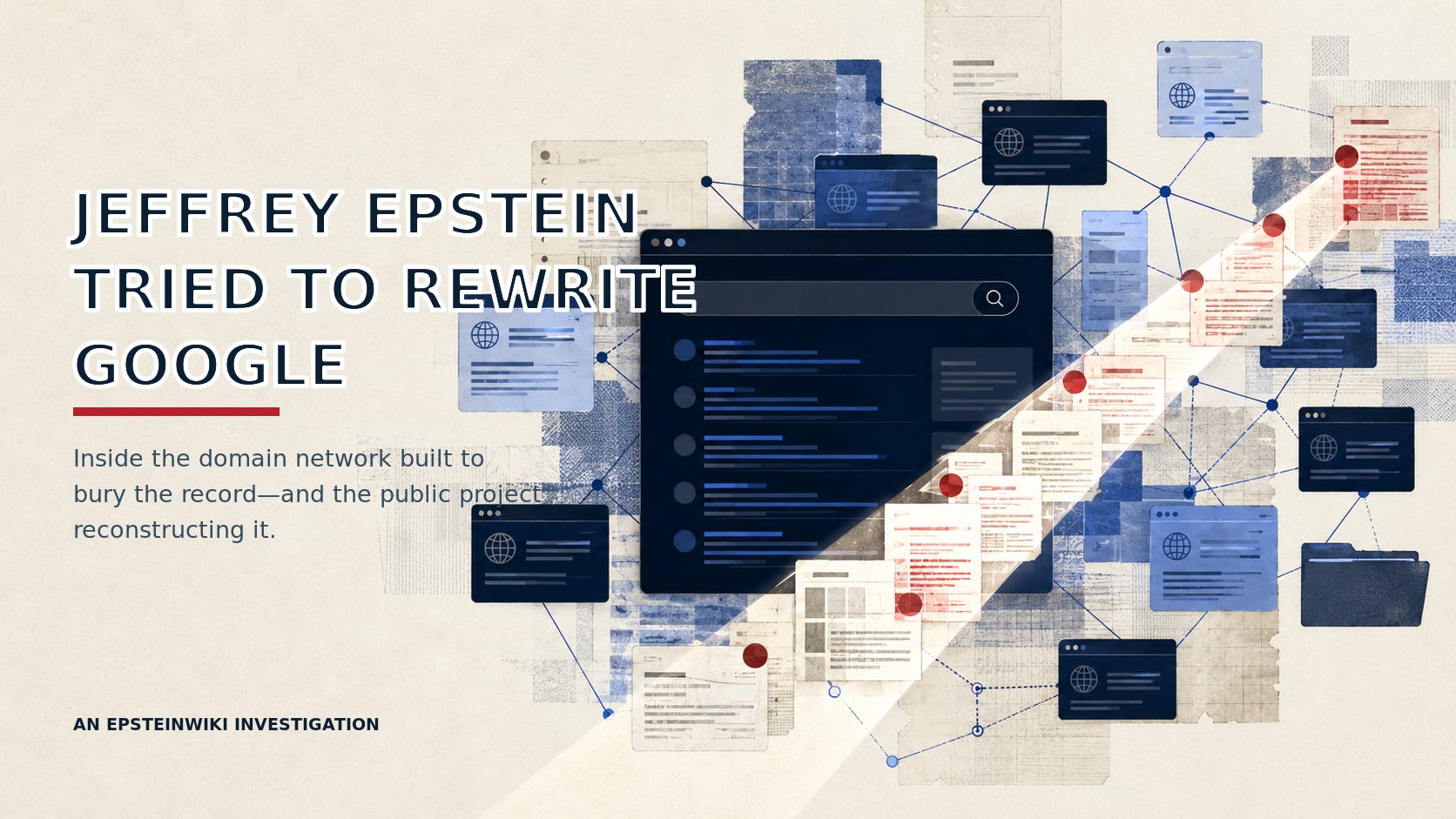
EpsteinWiki found 22 domains and hosted accounts, a $12,500 wire instruction, a campaign dashboard, Tumblr promotion, Wikipedia activity, and the digital remains of a machine built to push Epstein’s crimes down the page.
Jeffrey Epstein did not simply hope the internet would forget.
He approved a campaign designed to change what people found when they searched his name.
The receipts include a memorandum ordering a $12,500 wire to Reputation Changer, an email giving Epstein access to a campaign dashboard, instructions for creating websites and articles, a plan to promote an Epstein Tumblr account, and an attempt to replace his Wikipedia mug shot.
And here is the darkly satisfying twist: some of the clearest records survived because Epstein was a registered sex offender.
His representatives repeatedly reported internet identifiers to government authorities. Those disclosures preserved parts of the reputation machine that his contractors were building.
He tried to make the internet forget.
The registry helped us reconstruct the map.
Here Is What EpsteinWiki Found
Our complete EpsteinWiki investigation documents:
Twenty two domains and hosted addresses connected to the historical reputation network
A 2010 strategy for replacing unfavorable search results with science, philanthropy, sports, education, and foundation content
An April 2012 Reputation Changer proposal to suppress negative results across Google, Bing, and Yahoo
Epstein’s written approval of a Reputation Changer trial
A $12,500 wire instruction from Epstein’s account
A Reputation Changer account and tracking dashboard created for the campaign
Websites, press releases, blogs, guest posts, backlinks, social profiles, and staged article publication
A Tumblr address promoted through planned guest posts
An attempt to replace Epstein’s Wikipedia image and push back the mug shot
Efforts to promote unrelated people who shared Epstein’s exact name
Registry records documenting the network as it expanded and later contracted
This was not ordinary public relations.
Epstein had already been convicted and registered as a sex offender. The information being displaced included accurate reporting about his crimes and treatment of girls.
He did not need the internet to lie. He needed manufactured praise to overwhelm the truth.
The Registry Became an Accidental Evidence Archive
On November 1, 2011, attorney Darren Indyke notified the New York State Division of Criminal Justice Services that Epstein had opened the Twitter account jeffreyepstein1. The notice appears in EFTA01110814.
The registry returned the notice because Epstein had not signed it. A later letter in EFTA00686364 carried Epstein’s signature and expressly confirmed that he had opened the account.
Then, on January 24, 2012, Epstein submitted a much broader internet inventory. The cover letter appears in EFTA00586845, while the attached account list appears in EFTA00586846.
The inventory included email addresses, Twitter names, social profiles, hosted blogs, foundation pages, and custom domains.
Later registry material distinguished websites Epstein reported from additional properties created or maintained by outside reputation providers.
The irony is almost perfect. While his team tried to manipulate search results, the reporting process preserved a documentary trail of the infrastructure.
We searched for an email in which Epstein, Indyke, Christina Galbraith, or a contractor complained that registry reporting was embarrassing or interfering with the campaign. We did not find one.
We also did not find evidence proving that every website was reported to every jurisdiction on one universal six month schedule.
What the files establish is repeated reporting in 2011, 2012, and 2015. That is enough to document an evolving network. It is not permission to invent a conversation the records have not preserved.
The Blueprint Appeared in 2010
The plan was already taking shape in 2010.
EFTA02421209 documents a proposal to counter unfavorable search results with favorable material and technical intervention.
Related records in EFTA00754635, EFTA00754636, and EFTA00754637 describe Epstein websites and subject focused pages intended to occupy search results for his name.
Science, philanthropy, and sports became part of the public facing network. A captured search result in EFTA00752512 showed three favorable Epstein websites appearing on the first page of one Google search.
One screenshot cannot tell us what every user saw. It does show that favorable websites reached the search territory the campaign was targeting.
The $12,500 Wire and the Dashboard
The evidence now establishes that Reputation Changer progressed beyond a proposal.
On April 27, 2012, the company prepared a personalized action plan for Epstein. The proposal beginning in EFTA01176548 offered to suppress negative results by producing websites, articles, press releases, blogs, profiles, backlinks, and favorable search assets.
The proposal reached Epstein directly in May, according to EFTA02698102 and EFTA02698103.
Then came the October receipts.
In EFTA02562081, Galbraith described search optimization, a Virgin Islands website, published articles, BusinessWire activity, and a proposed Reputation Changer test.
Epstein replied, “ok lets try two months.”
On October 16, 2012, a memorandum from Harry Beller instructed a JPMorgan representative to wire $12,500 from Epstein’s account to Reputation Changer LLC. The reference identified the payment as “Jeffrey Epstein, 1 Month Trial.” The instruction appears in EFTA01580804.
The memorandum proves that the wire was ordered. It does not independently confirm that the receiving bank completed the transfer.
One day later, Epstein received instructions for accessing his Reputation Changer account and campaign dashboard. EFTA01993247 provided the company website, login information, and directions for opening the dashboard.
This was no longer a sales pitch.
Epstein had approved a trial. A wire instruction had been issued. A campaign account and tracking dashboard had been created.
Inside the Content Factory
The November 2012 correspondence shows the machine in production.
Reputation Changer representative Philippe Han discussed work involving Blogger, Weebly, WordPress, and JeffreyEpsteinFinance.com.
The records describe websites, press releases, twelve blog articles, guest posts, writers, editors, developers, password management, backlinks, and staged publication.
Han explained that articles would be released gradually because search engines favored repeated appearances of new content.
The correspondence in EFTA02024988, EFTA02024990, and EFTA02024991 documents the production strategy.
One technique was particularly slippery.
Guest posts did not always need to be about Epstein. Their promotional value could appear inside writer credits that linked the supposed author to an Epstein website. A page that looked independent could still send authority and traffic toward the reputation network.
This is how one favorable claim could become many search results.
A foundation supplied the story. Contractors repackaged it. Blogs, directories, press services, profiles, and branded websites repeated it. Search engines displayed multiple pages that appeared to confirm one another.
Repetition did not create independent corroboration.
It created volume.
The Dashboard Revealed the Assets
On January 2, 2013, an Epstein associated sender contacted Han after reviewing campaign links inside the Reputation Changer dashboard.
The message in EFTA01910318 reported a broken WordPress page, objected to images connected to Jux links, questioned the number of guest articles, and complained that social profiles displayed in the dashboard belonged to different people rather than Jeffrey Epstein.
The dashboard was not theoretical. Someone associated with the campaign was reviewing its assets and demanding corrections.
The unrelated profiles may have reflected an error or an attempt to occupy search space with other people who shared Epstein’s name. The email does not prove that Reputation Changer created or controlled them.
That distinction matters because an investigation should clarify uncertainty, not decorate it.
Tumblr Was Part of the Campaign
A January 17, 2013 update places epstein.jeffrey.tumblr.com inside the reputation operation.
Han told Galbraith that guest posts were being prepared to create links to selected Epstein websites and social accounts. One planned post was supposed to link to both jeffreyepsteinforum.com and the Tumblr address.
The update appears in EFTA02565446.
The same correspondence discussed press releases, sponsored reviews, an interview style guest post, and articles intended for websites Reputation Changer said it controlled.
The evidence connects the Tumblr page to the campaign. It does not identify who personally operated it or prove that every proposed link was published.
Wikipedia Was a Target Too
Wikipedia mattered because it could influence readers, search rankings, and the first image people associated with Epstein.
On September 16, 2013, Galbraith told Tyler Shears that she had uploaded a new image to Epstein’s Wikipedia biography with proof of ownership. She said she hoped it would “push back the mug shot.”
Epstein was copied on the email.
The same message discussed renewing Epstein’s science and education websites through GoDaddy. The correspondence appears in EFTA01959711.
The record proves that Galbraith reported attempting to change the image. It does not identify the Wikipedia account used or establish how long the replacement remained visible.
The campaign also promoted pages about unrelated people who shared Epstein’s exact name. The March 2014 messages in EFTA01928953 and EFTA01928954 show that exact name results were valued because they could occupy search space.
Those unrelated people should not be described as participants. The correspondence shows that their pages were selected for promotion, not that they cooperated.
What Happened to the Domains
EpsteinWiki has now documented 22 domains and hosted addresses connected to the historical network.
Some old blogs remain accessible. Several custom domains expired and were registered again years later. Some are parked for sale. Some do not resolve. At least one recreated sports site cannot be authenticated as an original Epstein property. Several current registrations use privacy services that conceal the purchaser.
A matching name does not prove continued ownership by Epstein, his estate, or his former contractors.
Historical authenticity and present ownership are separate questions.
There is also one ending Epstein could never have anticipated.
jeffreyepstein.net, once associated with his reputation operation, is now controlled by a volunteer working with EpsteinWiki. It redirects readers to the evidence project.
A domain once used to improve Jeffrey Epstein’s image now points toward the records showing how that image was manufactured.
Why This Matters
This was not harmless vanity.
Search results could affect whether a journalist kept digging, whether a university accepted money, whether a scientist agreed to a meeting, whether a parent trusted an introduction, or whether a survivor’s warning was believed.
We cannot calculate how many decisions were influenced. We cannot prove that the internet campaign alone enabled later abuse.
But reputation infrastructure determines which warnings people find and which truths disappear beneath manufactured layers of philanthropy, science, and prestige.
That is why EpsteinWiki is preserving these websites, tracing the domains, linking the evidence, and stating exactly what each record does and does not prove.
Read the complete EpsteinWiki investigation for the domain inventory, timeline, technical fingerprints, archived pages, current ownership research, graphics, and primary evidence links.
If you possess historical screenshots, registration records, archived pages, invoices, or correspondence connected to these sites, preserve the original file and contact EpsteinWiki.
He tried to make the internet forget.
The records remembered.
Selected Reporting and Evidence
 | A guest post by
|
Michael Wolff was instrumental in the campaign you talk about.